

Wonder Spoon · photographic comparison
Wonder Spoon
Upper and underside photographs make the construction as interesting as the paint.
- Existing attribution
- The filenames and existing website identify this group as Wonder Spoons. This is a photographic group record, not three authenticated object records.
- Visible evidence
- The upper image shows a multicolored example with a red feather tail, a red-and-cream example with a feather tail, and a yellow-and-black example with an exposed treble hook.
- Strongly supported inference
- The two photographs appear to show the same three examples, based on their appearance and attachments; the pairing has not been independently confirmed.
Sources & record notes
Photographic or documentary record LLA-REC-0003 · Reviewed September 2026. Record identifiers describe the material shown here; they are not accession numbers for authenticated physical objects.
Back to the collectionProvenance
The photograph is retained from the earlier Lauby Lures website. The original photographer and capture date have not been established.
Use the identification guide to record measurements, markings and missing views. Measurements and originality remain unverified for the examples on this page.
Cite this record
Lauby Lures. “Wonder Spoon.” Record LLA-REC-0003. Updated September 13, 2026. https://www.laubylures.com/collection/wonder-spoon. Accessed [your access date].
Publisher: Lauby Lures. Submit a correction or additional evidence.
Physical-object documentation
This is a photographic record; no physical inspection or measurements have been completed for this archive. Use the recording standard to add verified dimensions, markings, individual photographs and provenance.
A design developed through manufacture
The 1939 catalog presents the Wonder Spoon as a buoyant wobbler whose tail action could be retained with different hook dressings. It emphasizes the direct wire connection between line and hook. These are the maker’s explanations of its design. 1939 catalog, reproduced in Slusar, pp. 369–371.
Slusar traces a progression from asymmetrical early spoons to fully concave production bodies, then versions hollowed over roughly three-quarters of the underside. His account describes the later flat-backed Badger form as a response to production cost. Slusar, pp. 365–368, 372.
The casting sizes in the 1939 catalog
| Catalog entry | Advertised length |
|---|---|
| Bass 1T | 2½ inches |
| Bass 2T | 3⅛ inches |
| Wall Eye 3T | 3⅜ inches |
| Pickerel 4T | 3⅝ inches |
| Muskie 6T | 4¼ inches |
| Lake Trout 10T | 6¼ inches |
Catalog reproduction, Slusar p. 369. These are advertised sizes, not measurements of the three photographed examples. Fly-rod entries appear separately on p. 371.
From the printed record
Patterns and early forms
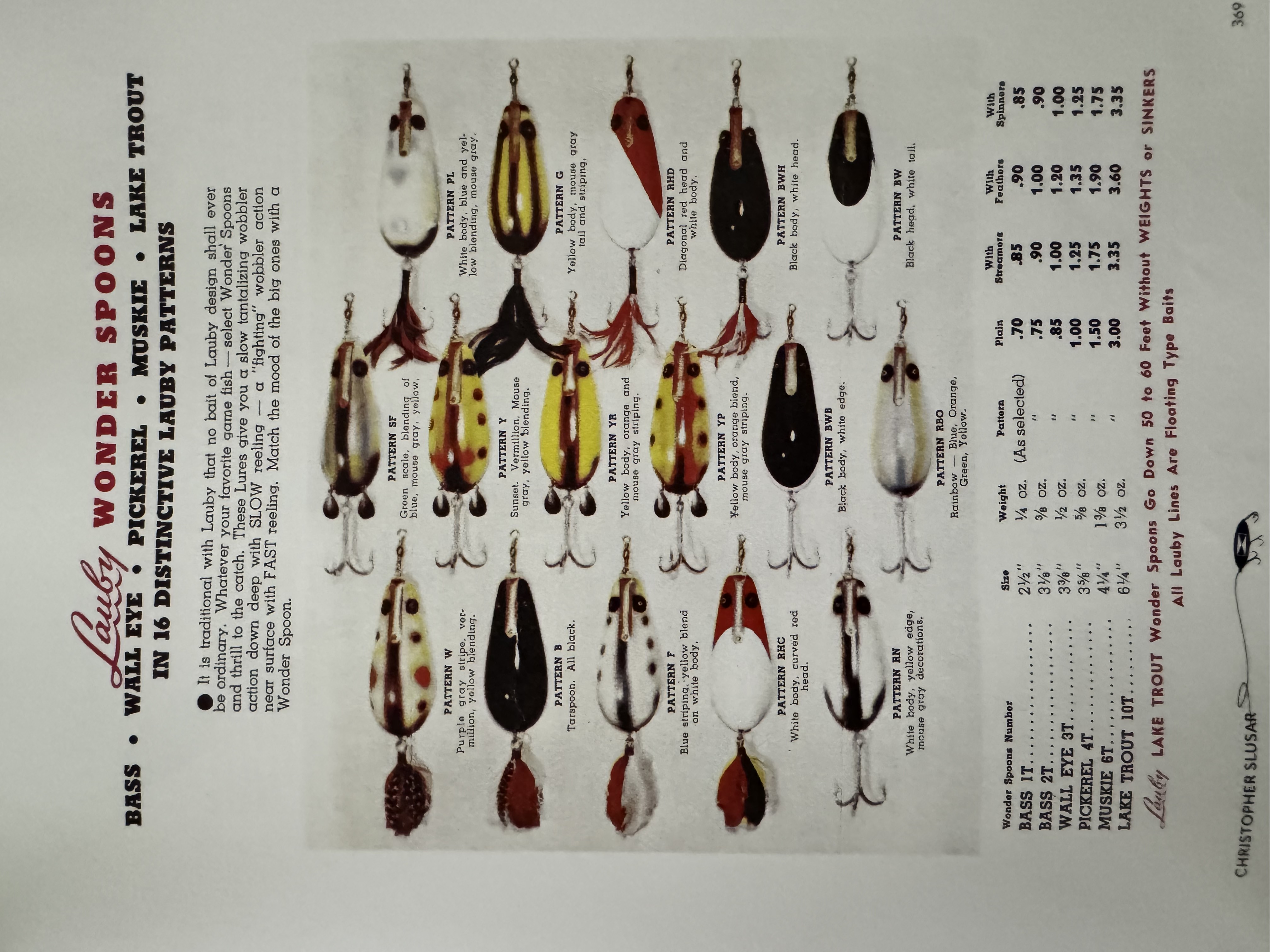
Sixteen patterns, one Wonder Spoon
The 1939 catalog’s Wonder Spoon color chart, with advertised casting sizes and prices. Reproduced in Christopher Slusar’s history, p. 369.
Source detailsSelect image to enlarge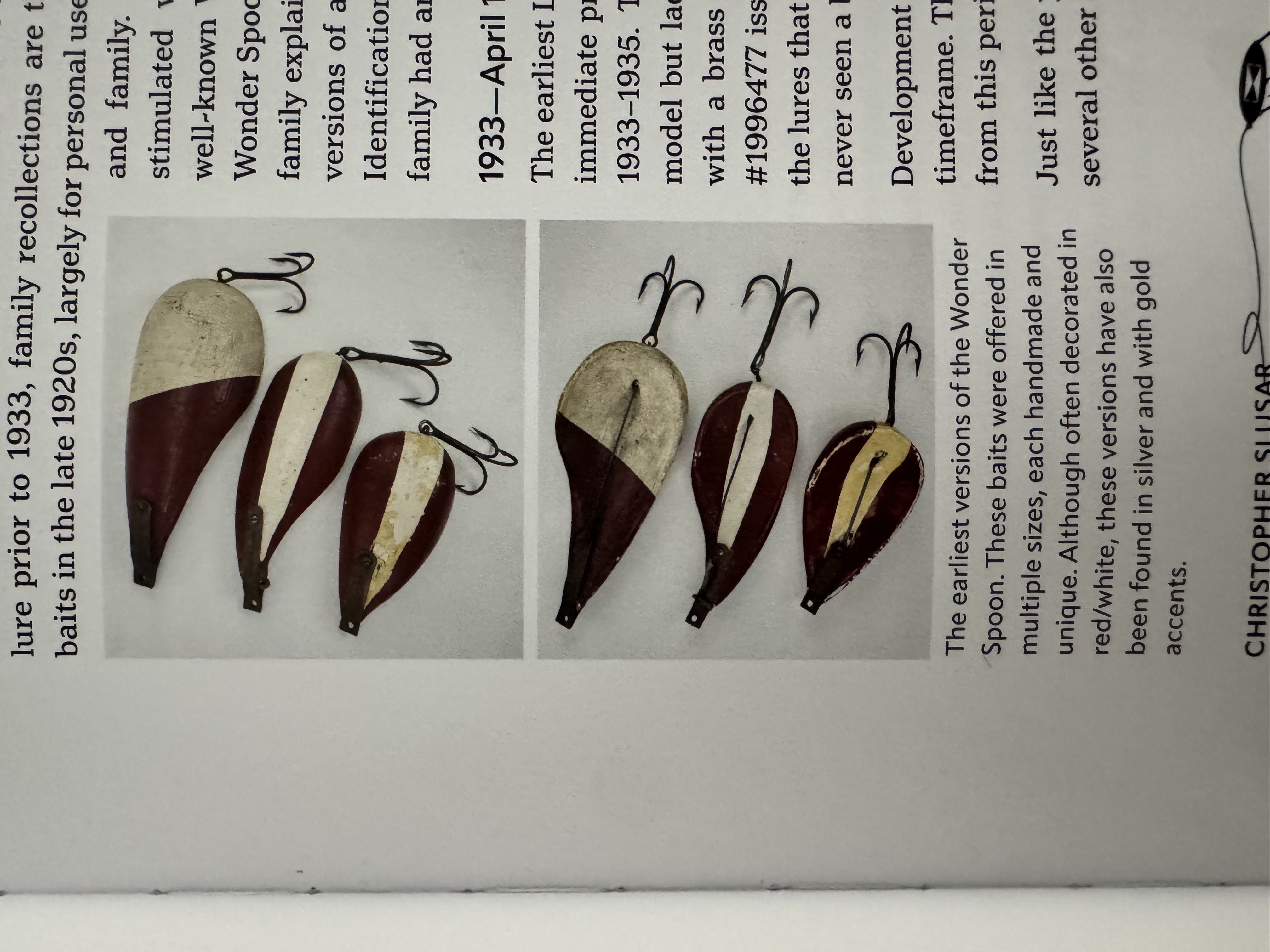
Early spoon forms
Upper and underside photographs of early Wonder Spoons reproduced in Slusar, p. 365. These published examples illustrate the asymmetrical body form discussed in his account.
Source detailsSelect image to enlarge